
Affiliate Tracking Without Third-Party Cookies
Browsers are killing third-party cookies, and most affiliate platforms rely on them. Trackli uses 90-day first-party cookies from day one — set on your own domain so Safari's ITP, Firefox's ETP, and Chrome's privacy changes have no impact on your affiliate tracking.
How to Set Up Cookie-Free Tracking Affiliate Tracking
Get up and running in minutes with these simple steps.
Deploy First-Party Tracking
Trackli's script runs on your domain as a first-party script. No third-party domains, no cross-site cookies, no browser blocking.
Set Up Deterministic Matching
Trackli uses URL parameters and first-party cookie sessions for attribution — no probabilistic device fingerprinting, no cross-site tracking.
Fingerprint-Free Privacy
Trackli avoids probabilistic fingerprinting. Attribution is deterministic: URL parameters carry the referral, and the first-party cookie preserves it through the conversion.
Verify Privacy Compliance
Review Trackli's privacy-compliant approach. No personal data is shared with third parties, and tracking respects user consent preferences.
Test Across All Browsers
Verify tracking works in Safari (ITP), Firefox (ETP), and Chrome with third-party cookies disabled. Trackli is tested across all major browsers.
How It Works
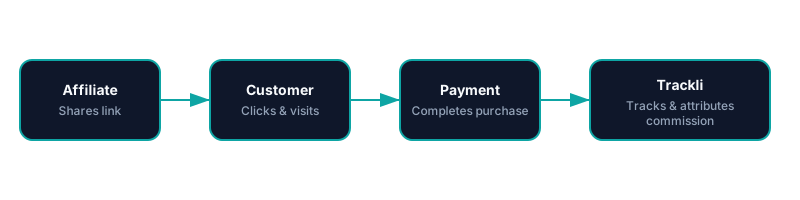
From referral link to commission approval — fully automated with Cookie-Free Tracking. You pay your affiliates however you already do.
Frequently Asked Questions
Why are third-party cookies a problem for affiliate tracking?
How does Trackli track without third-party cookies?
Does Trackli use device fingerprinting?
Is Trackli compliant with GDPR and CCPA?
Will my tracking break when Chrome removes third-party cookies?
Related Use Cases
Explore more ways to use Trackli for affiliate tracking.
Affiliate Tracking Without Complex Networks
Affiliate networks like CJ, Awin (which absorbed ShareASale in 2025), and Impact take a cut of every commission, sit between you and your affiliates, and add setup you don't need. Trackli lets you run a direct affiliate program where you own the relationships, keep the data, and avoid middleman costs — all with simpler setup than joining a network.
Learn moreAffiliate Tracking with Promo Codes
Give every affiliate their own promo code. When a customer redeems it at checkout, Trackli credits that sale to the affiliate — no link click needed. That covers podcasts, YouTube, newsletters, print and in-person mentions, and it runs alongside your normal referral links, so one affiliate can use both.
Learn moreLightweight Affiliate Software for SaaS
Most affiliate platforms are built for enterprise with features you'll never use and prices to match. Trackli strips away the bloat and gives SaaS companies exactly what they need: reliable tracking, automated commissions, and a clean affiliate portal — without the complexity tax.
Learn moreReady to launch your affiliate program?
Start tracking affiliate referrals in minutes. No complex setup, no enterprise pricing.